For decades, friction-reducing coatings have been used to facilitate the insertion and placement of devices within the body. These coatings are often used on devices designed for use in the arterial and venous systems. Common products that use coatings to reduce friction include stents, catheters, bioabsorbable scaffolds, guidewires and other products that are in contact with the bloodstream. This is because blood becomes notoriously tacky the longer a device is in the artery or the vein, and can result in a device performing suboptimally.
Today, there are a variety of surface modification options available to device engineers, from hydrophobic to hydrophilic coatings. This allows them to select the solution that best matches their specific design and performance requirements.
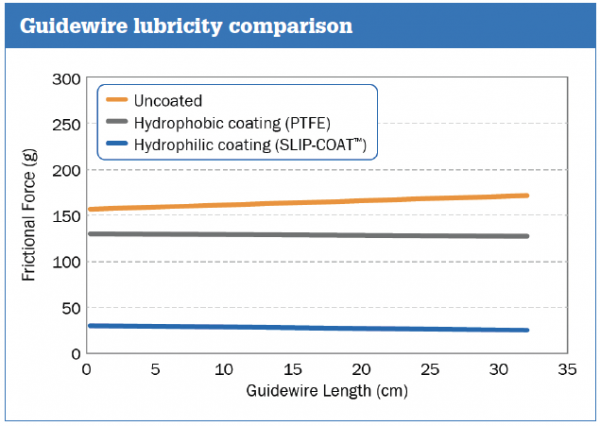
One of the original coatings used in the medical field is polytetrafluorethylene (PTFE). Widely used to coat guidewires, PTFE has the unique property of providing a low-friction surface in the dry state. Unlike hydrophilic polymers, PTFE does not need to be wet to provide lubricity. By contrast, polymers in hydrophilic coatings such as polyvinylpyrrolidone, which is contained in Argon Medical’s SLIP-COAT, absorb aqueous liquids to make the surface slippery when wet. This feature makes hydrophilic coatings more lubricious than PTFE coatings. Below is a graph comparing the force required to pull stainless steel guidewires between two silicone pads with 500g of applied force. Although the PTFE coated wire has lower frictional forces compared to the uncoated wire, the wire coated with SLIP-COAT is significantly more lubricious than both the uncoated and a PTFE coated wire.
Lubricious coatings are commonly applied to the outside surface of devices by dip, spray or wipe, followed by either curing with ultraviolet (UV) light or heat drying.
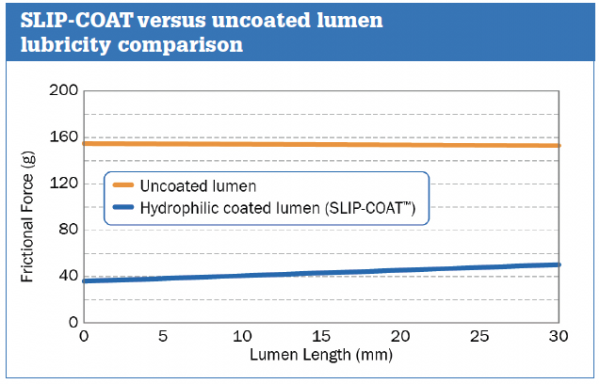
However, applying a coating to the inner lumen of a catheter is not as straight forward and presents a unique set of challenges. The first challenge is to introduce the coating solution into the lumen. This can be accomplished by injecting the solution with a syringe and then draining or flushing out any excess. The coating solution should have low viscosity so it can easily flow through the inner lumen without leaving too thick of a layer behind. The next challenge is to cure or bond the coating to the surface. A preferred method when coating lumens is to use a heat-curable coating to avoid the line-of-sight issues associated with UV-curable coatings. With a heat-curable coating, it is important to formulate with low-boiling solvents to facilitate their removal during the oven drying process. Blowing warm air down the lumen can accelerate this process.
Above is a graph showing the friction reduction when pulling an uncoated polyurethane tube out of the inside of a larger polyurethane tube. The lumen that was coated with SLIP-COAT dramatically reduces the frictional forces when passing one surface over another.
Friction reducing coatings have been, and will continue to be, an essential component of a variety of medical devices. The ability for a coating to be customised to meet all of the design and performance characteristics of a device is critical to the success of the product. Argon Medical’s SLIP-COAT can be tailored to meet a manufacturer’s requirements for the level of lubricity and the length of time a device remains lubricious. This customisation, combined with its ability to be heat cured, makes it a favourite solution for many manufacturers of vascular devices.
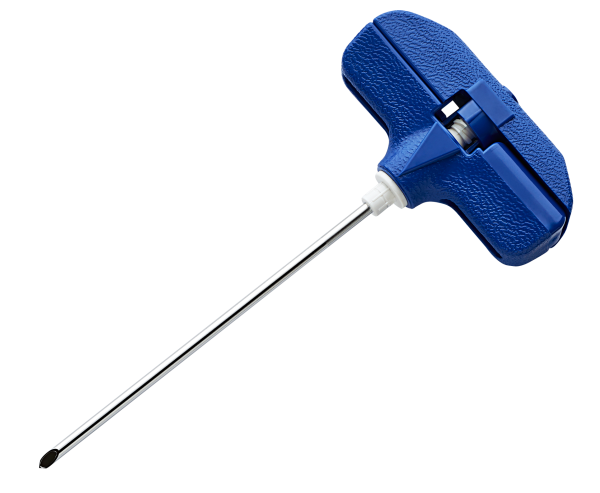
Trusted, high-quality needles are required for interventional procedures such as kyphoplasty, vertebroplasty, bone access and bone marrow biopsy, as well as orthopaedic and spine surgeries. Although the need for such bone needles is common, finding a specialised needle that specifically matches your requirements can be a challenge because the procedural outcome, ease of use, and patient and clinician comfort is greatly impacted by the needle’s point geometry, cannula design and handle ergonomics.
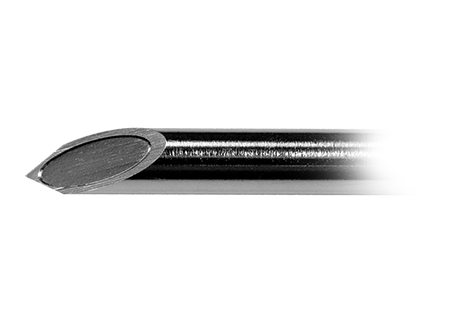
Grinding the needle point geometry is a critical process in manufacturing a perfect needle. This is especially evident in bone access and bone marrow harvest needles where the point geometry directly affects insertion force and patient comfort, and can impact the overall success of the procedure.
“Grinding the needle point geometry is a critical process in manufacturing a perfect bone needle.”
Argon Custom Product Solutions provides a wide variety of point geometries, including: the double-diamond point designed to easily penetrate hard bone; an industry leading ‘match-ground’ tip where the needle and stylet are uniquely matched one-to-one during grinding, for a perfect needle point; and electrochemical grinding and notching for custom features specific to customer needs.
Cannula design is also an important feature for bone needles. Some design options to consider are shaping the tubing or wire to strengthen the hub bond, modifying the funnel entry for accepting a device into the tubing inner diameter, designing the cannula to capture and retain outstanding-quality bone marrow specimens, or adding centimeter depth markings.
From custom point geometries to specific cannula designs, Argon Custom Product Solutions offers CNC Swiss Machining, and a variety of metal processes, such as swaging, bending, flaring, electrochemical ‘burr-free’ cutting and chemical etching.
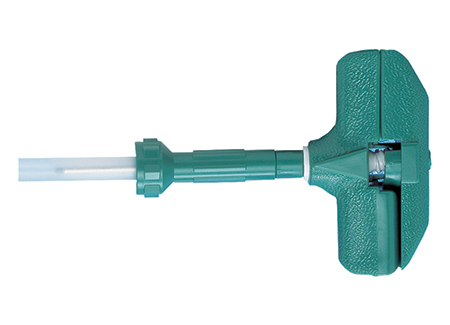
Another important feature of a bone needle is the ergonomic handle design. Handle designs have improved greatly over the years to improve needle control and clinician comfort.
Additionally, adding custom features to the handle design, such as a pad-printed logo or a specific handle color, can enhance marketing efforts and increase brand awareness.
As a leading provider of bone access needles, Argon Custom Product Solutions offers a comprehensive range of ergonomically designed handles in a variety of shapes and colors.
packaging options Some projects prioritize speed and time-to-market, when there simply isn’t enough time or budget to source a customized bone needle. For such situations, there are off-the-shelf options that are ideal. Argon Custom Product Solutions has a vast portfolio of ready-to-order needles specifically designed for bone access, bone biopsy and cement delivery, with leading edge design features built in for optimal ease-of-use and patient outcomes.
Packaging is another important consideration for your bone needle project. Packaging options range from bulk non-sterile to custom single-pack sterile.
Although sourcing your needle bulk non-sterile might seem to be the easiest and least-expensive solution, partnering with a supplier in order to provide a sterile, private-label-finished device can help reduce overall lead time and total cost of ownership.
Argon Custom Product Solutions offers a wide variety of both custom and standard packaging options, including form-fill-seal, vacuum forming blister trays, peel pouching, and private label and custom packaging.
Quality as standard
Argon Custom Product Solutions is a proven quality supplier of needles for bone, biopsy and vascular access, and a respected leader in medical device manufacturing, with custom and standard product offerings for components, accessories and private-label finished devices.
Argon’s experts are available for the company’s clients to contact and discuss their projects.


